
Showing posts with label elementary grammar. Show all posts
Showing posts with label elementary grammar. Show all posts
Thursday, 14 March 2019


Monday, 19 November 2018

Tuesday, 25 April 2017
Recognizing the Past, Present and Future Simple tenses
There is a video underneath the puzzle - "The Opposites" (kids can watch and move - great for a short break).
Tuesday, 8 November 2016
At School (an interactive worksheet)
Students watch and listen to the audiobook "At School" by Potato Pals, then sing along with them in the second video and do 3 activities afterwards.
Here's the link for students and here's one for teachers.
Here's the audiobook with pictures.
Here's the link for students and here's one for teachers.
Here's the audiobook with pictures.
Monday, 31 October 2016
In The Evening (an interactive worksheet)
There are 3 follow-up activities to be used after watching the video. Here's the link for students and here's one for teachers.
Wednesday, 5 October 2016
In the Morning (3 interactive worksheets)
First, students watch the videos "What do you do in the morning?" by Potato Pals and do Activity 1 (to revise colours, numbers, verbs can, have got, to be). Here's the link for teachers.
Here is the audiobook.
After that, they do Activity 2 (positive sentences, 3-rd person singular ) and Activity 3(questions with do/does). Here are the links for teachers: Activity 2 and Activity 3
Here is the audiobook.
After that, they do Activity 2 (positive sentences, 3-rd person singular ) and Activity 3(questions with do/does). Here are the links for teachers: Activity 2 and Activity 3
Thursday, 4 December 2014
My Room Game - Prepositions of place
In this powerpoint game students learn/review the prepositions of place (in/on/under/next to/above/near/in front of), pronouns it/they and some furniture words.

Tuesday, 7 October 2014
Review the possessive adjectives my/your, his/her with this ppt game

Thursday, 17 July 2014
A calendar with lots of activities (4 seasons) to practise speaking/writing
Here are some ideas on how to use this calendar:

- As you can see, each month has three identical weeks and one different, which can be used for practising Present Simple/Continuous (e.g. I usually go to the swimming pool on Friday, but today I'm going to the skating rink.), Present Perfect (e.g. I have been to the cinema three times this month.), Past Simple/Continuous ( e.g. I called you yesterday but you weren't at home. - Oh yes, I was having a karate lesson then.)
- Practise saying the date, review days of the week
- Learn/review lots of action verbs/places
- Practise using "going to", "have to", "must"
- Revise the prepositions of place and time (in February, in winter, on Monday, on the 1st of August, at the weekend, at the beginning/end/in the middle of the month/week, at the cinema, to the theatre)

Friday, 28 February 2014
Boys and girls - a speaking game/activity for young students
I made this game to help my first and second graders learn to talk about people's names, age and mood (sad/happy). It's also a good way to revise colours and numbers (1-14), as well as practise making affirmative, negative and interrogative sentences using to be (am, is are) and different pronouns.
There are 14 boys, 14 girls and 7 sets of tockens. Here's an example of how to play:
Spread the boy cards on the table and hide 7 pots with gold and 7 ghosts underneath. Your partner looks away so that he doesn't see where you place the tockens. He turns back when you're ready and describes one of the boys (He is red and happy. What's his name? How old is he?) You answer the questions, pick up the card and put it away. Your partner gets the tocken hidden under it. Then he chooses 6 more boys and you both follow the same pattern again. The aim of the game is to get as many pots with gold as possible. Once your partner has chosen 7 boys, then it's your turn to guess. In the end, you compare the number of pots with gold you've got and find out who the winner is.
This is only one of many possible variations. You can use other tockens as well, or only one of them (put it under one of the boys/girls cards and let your partner guess the card you've chosen - asking questions, of course). The Easter eggs could be used for Egg Hunting game. Children can also practise spelling the names on the cards, thus revising the alphabet. You can practise using have got/has got, possessive pronouns (my/her/his/their etc.) Just use your imagination :-)

There are 14 boys, 14 girls and 7 sets of tockens. Here's an example of how to play:
Spread the boy cards on the table and hide 7 pots with gold and 7 ghosts underneath. Your partner looks away so that he doesn't see where you place the tockens. He turns back when you're ready and describes one of the boys (He is red and happy. What's his name? How old is he?) You answer the questions, pick up the card and put it away. Your partner gets the tocken hidden under it. Then he chooses 6 more boys and you both follow the same pattern again. The aim of the game is to get as many pots with gold as possible. Once your partner has chosen 7 boys, then it's your turn to guess. In the end, you compare the number of pots with gold you've got and find out who the winner is.
This is only one of many possible variations. You can use other tockens as well, or only one of them (put it under one of the boys/girls cards and let your partner guess the card you've chosen - asking questions, of course). The Easter eggs could be used for Egg Hunting game. Children can also practise spelling the names on the cards, thus revising the alphabet. You can practise using have got/has got, possessive pronouns (my/her/his/their etc.) Just use your imagination :-)

Wednesday, 14 August 2013
The verb TO BE and Fairytale characters - Four In a Row game

For example: I am a princess/ He isn't a king/ Are we clowns?
If the sentence is correct, he draws something inside the chosen square (we use snowflakes and hearts or flowers). If he makes a mistake, his opponent has a chance to correct it and draw his own sign instead. The first one to make a row of four signs (either in a vertical, horizontal or diagonal position) is the winner.
There are 2 different sets to play with.
Saturday, 4 May 2013
Countries and nationalities - a speaking activity
Here's how we play this game in class:
1. A student chooses a girl (from the first slide)and the others guess who it is, asking the following questions: Is she German? Is she 8 years old? Is she from France? Is her name Ann?
The student has to give short answers (Yes, she is/No, it isn't, etc.)
2. After that the student turns away from the screen and answers his fellow students' quesions about the girl he's chosen (this time special quiestions, like "What's her name? How old is she? Where is she from? What nationality is she?")
3. Do the same with the slides showing boys and pairs of people.

Download the activity
1. A student chooses a girl (from the first slide)and the others guess who it is, asking the following questions: Is she German? Is she 8 years old? Is she from France? Is her name Ann?
The student has to give short answers (Yes, she is/No, it isn't, etc.)
2. After that the student turns away from the screen and answers his fellow students' quesions about the girl he's chosen (this time special quiestions, like "What's her name? How old is she? Where is she from? What nationality is she?")
3. Do the same with the slides showing boys and pairs of people.

Download the activity
Monday, 1 April 2013
Day Chart and Past Simple Practice
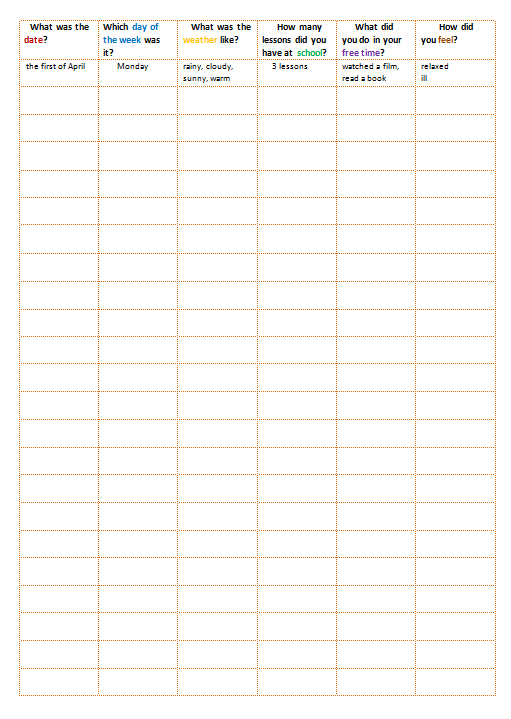
First they make affirmative sentences about each item in their chart. Then I make some false statements and they have to correct them (using negative sentences). Then they check how well I remember the information just provided by asking me questions.
They can do this in pairs. The chart can be used for practising the Present Simple tense as well. For example, On Mondays we usually have six lessons, but yesterday we had only four.
Monday, 17 September 2012
Talking about people - 8 activity cards

First, each student takes a card and tells the class about the child/children on his card.
Next, each student chooses a card and the others ask him/her special questions to find out as much information as possible. Then they say what they've found out about that person.
Finally, students work in pairs and try to guess which picture their partner has chosen. They ask general questions about age, clothes, food, favourite season, hobbies, country and nationality and name.
The activity cards are editable.
Monday, 5 March 2012
Just Me And my Dad - Part 2
Here's the second part of the video. You'll find some online activities to use with it here.
There are 6 activities (True/false, choosing the correct verb form, completing the song with the missing words, numbering the pictures in the correct order and writing the story).
You can use the interactive book from Mercer Mayer's website to practise speaking (retelling the story, using different tenses etc.)

Wednesday, 30 November 2011
Just Me And My Dad - Part 1 - video,activities and transcript
 You can show your students this funny video and use the worksheet as a follow-up (matching, true/false, completing sentences with the new words, present/past simple, asking questions and making negatives in
  Past Simple). My students liked the video a lot and I'm sure yours will, too :-)
Wednesday, 24 August 2011
What a Pretty Girl! - Speaking and Writing Practice For the Youngest Students
I love using online games during my lesssons. It takes some time to find a proper one, but it's worth it. Here is the game I use with my 2-nd formers to give them some practice in describing people's appearance. It is ideal for their level as the vocabulary used there is just what they need right now.
 Pupils click on the words one by one, choose the style they want and describe it.
She has/has got green eyes.
or Her eyes are green.
You can also practise other grammar aspects:
These are eyes. They are green.
This is a nose. It is small.
You can ask your pupil questions and they give short answers.
 Here is a worksheet you can use as a follow-up activity (hometask).

She has/has got green eyes.
or Her eyes are green.
You can also practise other grammar aspects:
These are eyes. They are green.
This is a nose. It is small.
You can ask your pupil questions and they give short answers.

Thursday, 21 April 2011

Sunday, 17 April 2011
Speaking Practice for beginners - AM/IS/ARE and prepositions of place
Here are some ideas on how to practise using the verb To Be in The Present Simple as well as prepositions of place. Take 8-10 different toys (school objects, flashcards etc.) and preferrably in pairs of various size and colour (for example, 2 rabbits - a small red one and a big pink one, 2 cars - a blue one and a black one). Put all the toys into a bag.
IS Affirmative
Take a toy from the bag, describe it and it is "yours". (It is a doll. It is small and pretty.)
Keep your toys near you. Your partner does the same, so in the end you both have 2 piles of toys. Then you describe one of the toys your partner's got and he/she has to guess what it is.
( It is small and red. - It is a car!)
IS Negative
Now describe the toys using "not" and let your partner guess.
(It is not big and it is not black. - It is a rabbit!)
IS Questions ans short answers
Your partner turns away and you put one of the toys into the bag. He/she must guess what it is without looking at the remaining toys.
e.g. Is it big? - No, it is not.
Is it red? - Yes, it is.
Is it a puppy? - No, it is not.
Is it a kitten? - Yes, it is.
ARE
Do the same as with IS, but this time take 2 toys to speak about. As it may be difficult to find 2 big dolls, 2 red cars etc. you can use the prepositions of place when talking about toys. Put the toy pairs in different places and describe what you see. ( They are dolls. They are on the table.)
You can play the guessing game using the prepositions of place.
AM
Talk about yourselves:
+ I am Oksana. I am short and thin. I am on the sofa. I am happy.
- I am not Ann. I am not sad. I am not on the floor. I am not tall.
To practise questions you can do something funny like sit down on the table and ask your partner: "Am I under the table?" - Yes, you are. /No, you are not.
Then you can make a sad face and ask "Am I glad?"
IS Affirmative
Take a toy from the bag, describe it and it is "yours". (It is a doll. It is small and pretty.)
Keep your toys near you. Your partner does the same, so in the end you both have 2 piles of toys. Then you describe one of the toys your partner's got and he/she has to guess what it is.
( It is small and red. - It is a car!)
IS Negative
Now describe the toys using "not" and let your partner guess.
(It is not big and it is not black. - It is a rabbit!)
IS Questions ans short answers
Your partner turns away and you put one of the toys into the bag. He/she must guess what it is without looking at the remaining toys.
e.g. Is it big? - No, it is not.
Is it red? - Yes, it is.
Is it a puppy? - No, it is not.
Is it a kitten? - Yes, it is.
ARE
Do the same as with IS, but this time take 2 toys to speak about. As it may be difficult to find 2 big dolls, 2 red cars etc. you can use the prepositions of place when talking about toys. Put the toy pairs in different places and describe what you see. ( They are dolls. They are on the table.)
You can play the guessing game using the prepositions of place.
AM
Talk about yourselves:
+ I am Oksana. I am short and thin. I am on the sofa. I am happy.
- I am not Ann. I am not sad. I am not on the floor. I am not tall.
To practise questions you can do something funny like sit down on the table and ask your partner: "Am I under the table?" - Yes, you are. /No, you are not.
Then you can make a sad face and ask "Am I glad?"
Wednesday, 6 April 2011

Subscribe to:
Posts (Atom)